Showing posts with label Missouri. Show all posts

Tuesday, September 11, 2018

Week 2 - Edging

by Striking Dervish


Week 2 is dedicated to the concept of edging. Edging is essential in order to do more than just move forward.

Some basics about edging

The term edging is commonly associated with ice hockey because the blade on the bottom of an ice hockey skate has edges to it. The transfer of weight to the inside and outside edge is essential for turning and performing various skills.
Quad skates work in a similar manner with a truck underneath the skate that can move from side to side. Applying pressure with the outside or inside of your foot will move your trucks back and forth and allow for turning. Part of the reason why your skates should be fitted well to your foot is so that the trucks respond well to what your feet are telling it to do!
If you have brand new skates, the trucks will likely be stiff, so you’ll want to have them loosened. Please ask a vet or coach at practice if you need to loosen your skates. Many will have a tool and can help you. Usually, the best option is to loosen it a quarter turn per practice or skate session until it feels comfortable.

Two-Footed Edging

To get the idea of how edging works, we start by practicing it on two feet. To turn, you must push down on the side of the skate towards the direction you want to turn. In that way, to turn left, you should push down on the outside of your left skate and the inside of your right skate. Similarly, to turn right, you should push down on the inside of your left skate and the outside of your right skate.

Skiis

The skill we call “skiis” looks very much like someone skiing down a slope, moving from side to side to navigate the terrain and control speed.
Start by striding a couple of times to get moving. Then with your feet together, use the edging concept to make your skates turn in one direction and then switch sides to turn in the other, making a weaving motion. Here are a couple of other points to think about to help with the skill:
  • Think of pointing your toes and knees in the direction you are turning.
  • Try to avoid only using your knees to turn yourself; more of the motion should be in the feet/ankles.
  • Throwing your hips towards the outer point of your arc will help the turn-back to the opposite direction.
  • Focus on keeping your upper body controlled; this skill mostly happens from the waist down.
  • As in all derby skills, remember to bend your knees!

Weaving Around Cones

Once you have the idea of edges, you can move on to targeted weaving by doing the same ski motion around a straight line of cones. The closer together the cones, the harder the skill will be. Be sure to stay low by bending your knees and dropping your butt. Do not bend over at the waist and lean over. The movement is really from the waist down, so your upper body should not move considerably. Avoid flailing your arms; instead keep them at your side, or if necessary while starting, out to the sides to also make note of whether or not you are tipping from side to side.

Watermelons

The watermelons we worked on in Week 1 can be improved by using the concepts of eding.  Instead of using them to turn by leaning your feet towards the same side of your body, we focus on leaning on the outside of both skates and then the inside of both skates. This back and forth motion will help move your feet out and in underneath you.

Figure 8’s

Figure 8’s are similar to a watermelon where the feet move out and in, but instead of bringing the feet back together side by side, you line them up one in front of the other, switching sides each time. Here are some points to keep in mind:
  • Remember to keep your knees soft and your butt down.
  • Avoid standing up when your feet come together.
  • Make sure you are using both legs. One leg may be stronger than the other, but you should not be moving one leg around the other each time. Work towards evening out the pull from each side to strengthen your legs if need be.

Cutting

Cutting refers to a more sharp turn accomplished by pushing on the edges of the skates harder than is necessary to just make a wide arc. Applied to derby, this allows for lateral movement on the track.

Cutting Cones

Cones are an extremely useful tool for practicing cutting because it serves as a gauge of how tight we can make our turns. When cutting around a cone, the foot closest to the cone should lead in front of the foot furthest from the cone. Concentrate on pushing down on the edges of your skates to turn around the outside of the cone. Some pointers to keep in mind:
  • Remember to stay low by keeping your butt down (not lowering your chest). Doing so will provide more balance and motion in the lower half of the body.
  • Avoid bobbing up and down between cones by staying low throughout the drill.
  • Avoid flailing the arms by keeping them at your sides. If necessary, hold your arms out to the sides to ensure you are not tipping your body from side to side during the drill. Most of the work should happen in the lower half of the body.
  • Do not look at your feet. Instead concentrate on the next cone in the series.
  • In order to switch you feet between cones, you can figure 8 in between them. Eventually, you will learn how to crossover in between them.

Cutting from Side to Side

Minimum skills testing does not include cutting cones, but skaters must be able to demonstrate the ability to cut from side to side on the track. Practice this by skating along the inside line and cutting out as quickly and sharply as possible to the outside line. Then cut from the outside line to the inside line.

One Footed Edging

Once you have the concept of edging down, challenge yourself to try edging on one foot. Being able to control your direction while on one foot is an essential building block for crossovers and various other derby skills.

One Footed Glides on a Turn

In Week 1, we practiced one footed glides in a straight line. Now we are focused on gliding around the turn of the track while balanced on one foot. The same key points apply:
  • Be sure you are balanced over the center of your base leg before picking up the other leg.
  • Keep your knee soft to help with your balance.
However, in order to turn, you will also need to focus on your edges! It will take time to find the right balance “sweet spot.” While you work on finding that spot, these things will help:
  • You will need to lean your body towards the center of the track. However, don’t “teapot” the top of your body; keep your core tight and drop your inside hip into the turn.
  • Keep your nose, chest, and knees pointing in the direction you are going (not towards the outside of the track). One way to encourage this posture is to tuck the arm closest to the inside of the track behind you.
Make sure you are practicing both legs! When traveling counterclockwise on the track (usual direction), that means you are balancing on the outside of your left skate when your left foot is down or balancing on the inside of your right skate when your right foot is down. Very often, finding the balance point of your outside foot is more difficult for skaters, but it very important for effective crossovers to work on it. When you get comfortable going the regular direction, try the clockwise direction!

Circles

For a more focused practice of the one footed edging, focus on a circle so that you are constantly turning. To get started, leave one foot on the ground and paddle with the other foot to gain momentum and get a feel for where you balance point should be. When you are ready, pick up the other leg and see how far you can continue turning with your leg up. Be sure to practice both legs in both directions!

Stopping

Plow Stops

Plow stops or snowplows are the second derby stop we learn. This stop allows for the skater to remain lower and more stable should they be challenged on the track while slowing. The stop is accomplished by turning the feet inwards so that they look similar to a wedged plow.
To execute a snowplow, widen your stance while skating and bring the feet together in a similar motion to a watermelon. Concentrate on pointing your toes inward and pushing your heels out and forward while pushing your inside edges (more edging!) into the ground but leaving all eight wheels on the floor. Your butt should act as a counterbalance by sitting back. Remember to keep your knees soft to increase stability and balance. The foot turn should begin from the wide stance and increase in pressure while the feet come together. The stop should occur completely by the time the feet are approximately shoulder width apart. Stopping while still in a wide stance will hinder consequent movement.

Conclusion

Being able to balance on your skates is extremely important for roller derby. Becoming familiar and comfortable on your edges will significantly help all skills in the upcoming weeks! Play around on your edges at open skates so you can find the right formula for turning, cutting, and balancing. Making yourself uncomfortable is often the only way to really get comfortable, so wear your pads and always remember that falling is learning!

Saturday, September 1, 2018

Toolkit for Practice

by One Hit Thunder
Gear


When coming to your first practice you will only need a few things in your toolkit:
  • Mouthguard
  • Safety Equipment – if you have it
  • Skates – if you have them
  • Water Bottle
  • Willingness to learn
  • Ability to listen – make sure not to have side conversations, everyone needs to hear the trainers instructions
  • Great attitude
  • Desire to have fun


As time goes on you may want to add to your toolkit.  We have compiled a list of items found in many vets bags. Don’t run out and buy everything on this list, every skater likes different things.
  • FullBag
  • Skate tools including a combo-tool, allen wrench set, adjustable wrench, bearing tool-remember you need to be able to adjust your trucks, toe stops, and wheels.
  • Duct Tape-this is used for many things including holding pads on to keeping skates from causing blisters.
  • Band-aids
  • Deodorant
  • Ibuprofen or other pain reliever
  • Baby wipes for cleaning wheels
  • Towel/handkerchief for sweat
  • Lace puller and shoe horn for getting skates tight
  • Granola Bar or Energy Chews
  • Chap stick
  • Anti-odor device – silica packs, a thin sock filled with crystal cat litter, zum yoga mat spray, febreeze, etc… everyone uses something a little different.
  • Dry bag for wet clothes
  • Water Bottle


You may also want to have some spare items too:
  • Laces
  • Mouthguard
  • Tights/leggings
  • Wheels and bearings
  • Water bottle
  • Shirts with name on the back in league colors for scrimmages
  • Socks
  • Hair ties
Every skater likes different things, so do not run out and buy everything listed above.  If you ever find yourself needing something, just ask, chances are someone will have just what you are looking for.

Wednesday, August 15, 2018

Safety Gear

by Mojo GoGo

For the FCRD Training Session

For the training sessions beginning in September, there will be limited quantities of used equipment available for new skaters. If you have not yet purchased your own equipment, plan to come early to practices to find equipment that properly fits you. It is recommended that you have at least your own mouth guard for all practices.
B & D Skating Rink will be offering a Fresh Meat Package. 


Kansas City is v. lucky to have a Derby 4 All store that you can walk into and buy equipment. 

Before You Buy, Remember…

This is the only body you have, so you want to protect it as best you can! Accidents happen and sometimes even the best protective equipment can’t save you from injury, but good quality equipment will keep you on the track and in better shape than cheap stuff.  You can also buy a $20 mouth guard from a sporting goods store, but a $0.99 version from Walmart will work just as well. The trick at this point is to balance cost and quality.

Look around and see what the vets are wearing. Ask them about their experiences with different brands of equipment and to try things on if possible. What one person thinks is the perfect knee pad may not work for another. And because that is the case there are lots of swap / trade / for sale used sites for derby equipment. Do some research and then buy smart.


First, take stock of your body and physical condition. Are you young and relatively healthy or do you have a few off road miles of fun in your past? Do you bruise easily or does it take a Mack truck to make a mark? Do you have more than a couple of broken bones in your past? If so, you probably want to spend a little more on protective gear to start out.

Also remember that safety gear is not intended to last forever. Much of it will stretch over time, especially knee and elbow pads, so buying a size that does not fit snugly now will likely not serve you for long.

The Essentials

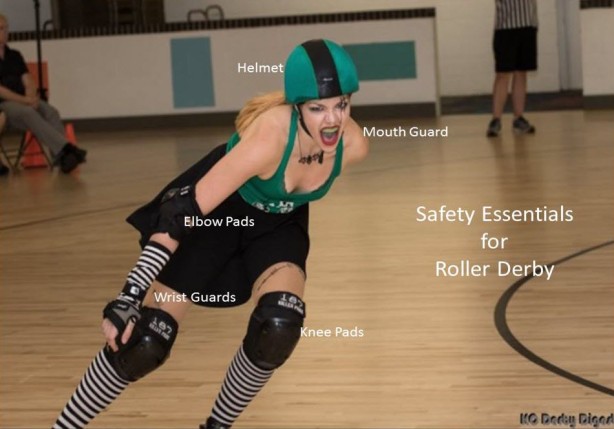
jukesafetygear1
Photo Courtesy of KC Derby Digest

Helmet

First, the item that protects your most important asset: the helmet. You only have one head and science hasn’t figured out how to replace them yet so you need to keep yours in good shape. There are lots of different helmet styles out there, from cheap bicycle helmets to expensive hockey helmets. Don’t just assume that because it is sold as “safety equipment” it will meet your requirements for protective equipment. Skate helmets should meet the ASTM F1492 standard for multiple lower-impact “trick roller skating” use. Bike helmets are not typically sufficient as they are CPSC standard for single high-impact use. Some helmets, however, qualify for both standards. Take some time to ensure that your helmet meets the right standard.
As for fit, the helmet should come down over the front of your head and the chin strap should be snug and secure. Your helmet should not be too tight or too loose. If your helmet is pushed back off your brow it may slide out of the way when you fall, allowing your forehead, nose or mouth to hit the floor and be injured. The helmet should be no further than two fingers above your brow line.

Mouth Guard

Next, your mouth guard. If you have had extensive (and expensive) dental work, check with your dentist to see what they recommend you wear. Otherwise there are a variety of products on the market. You can get some from sporting goods stores that range in price from $10 – $60 with dental insurance for you should something happen to your teeth while you are wearing their product. Walmart has inexpensive ones in their sporting goods section that work just fine for most people. (And the upside of cheap is that you can afford more than one so you can keep a spare in your skate bag just in case.) One of the most popular brands for roller derby players is SISU, which is more expensive but comfortably small and perforated to avoid excess spit buildup.
No matter which mouth guard you choose, remember you have to form it to fit your mouth. Don’t expect to just take it out of the package and pop it in your mouth and have it fit comfortably.

Knee pads

Right now, if you are still trying to master crossovers you are probably thinking you want the most low profile kneepads you can find. But you would be wrong. You are going to fall on your knees. A lot. At every practice. Sometimes on purpose, sometimes by accident. Trust us, the more padding your knee pads have, the better protection they will offer you and the happier you will be after falling drills. A good rule of thumb is to pinch the padding in the center of the knee plate and not have it feel like your fingers are almost touching. That is a sign of too little padding. The more you weigh, the more important it is to have a good amount of padding to protect you when you fall.
Other things to consider are size and how they go on. Some pads slide over your feet and up your leg, while others have straps that Velcro around. Most have additional straps that fasten below the knee to keep them from sliding out of place. Ask around for recommendations and try on different brands if you can.

Elbow Pads

The same advice applies to elbow pads. Although we don’t purposely fall on our elbows, you want a reasonable amount of padding and plate to protect you for those unexpected times when you can’t avoid landing on them.

Wrist Guards

There are many different styles of wrist guard to choose from, so as long as they offer the proper protection, the rest is up to your personal preference. Some have a plastic guard held in place by 2 Velcro straps while others fully encase your wrist and offer thick plastic cups on the palm of your hands. There are a million other styles in between. The main thing is to make sure they fit you snugly and will keep your wrist from hyper-extending or allowing your wrist to break if you hit the floor. If the plastic flexes or you have too much wiggle room, they will not protect you when you need it. If you are smaller you may need to buy children’s sizes to get them to fit correctly.

Optional Gear

Knee Gaskets

If you’ve had knee issues in the past, you will probably want to invest in added protection there. Gaskets are worn under the regular knee pad, provide an additional layer of padding and compression, and help keep the knee pad from slipping.

Tailbone Pads

Ideally, a roller derby skater falls forward to make use of his/her knee pads, or chooses a side to fall on if falling backwards. A fall straight backwards can mean tailbone trauma. Skate suppliers offer protection for the tailbone in the form of a clip-on pad to the back of the shorts or a pair of padded shorts to wear underneath regular practice/game clothing.

Wednesday, August 1, 2018

FCRD: A history


DGD, Season 1 - Photo Courtesy of Fire Branded Photography
DGD, Season 1 – Photo courtesy of Fire Branded Photography

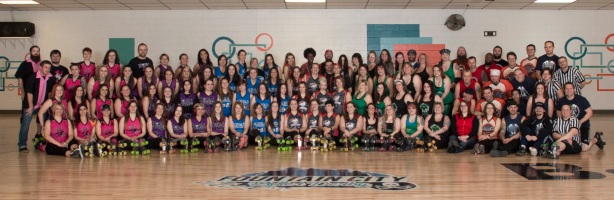
As we move on with the 9th Season of Fountain City Roller Derby (FCRD), it’s fun to look back to see where we’ve come from. FCRD actually started as Dead Girl Derby (DGD). In 2009, the founders of DGD broke off from the Kansas City Roller Warriors. The first season, DGD skated with two teams, Gang Green and Black Plague. The bouts took place at Northland Rolladium Skate Center in Liberty, MO, and the players for the two teams switched after every bout. If there was one thing DGD needed in its first season, it was bodies. It was not unheard of for girls to join the league and be thrown into a game a few weeks shortly thereafter. There was some training, but mostly a sink-or-swim attitude. The league was considered a non-profit organization and was skater owned and operated.


DGD must have been doing something right as it quickly grew to have enough skaters to have 4 teams (called “House” teams) for Season 2. Those teams were the Deadly Sirens, the Royal Pains, the Lovely Lethals and the Fearleaders. New skaters and returning skaters were thrown into a pot and drafted to the 4 teams by selected captains. These skaters would spend the entire season with the same team, a departure from the first season. Season 2 also saw the league move to RiverRoll in Riverside, MO for all of DGD’s games and practices. Each team played each other twice during the regular season.  At the end of the regular season, the teams with the two best records played each other in the first ever championship game. While the Deadly Sirens came in as the proverbial favorite, the Lovely Lethals prevailed and became the first champions of DGD.  
DGD Season 2 - Photo courtesy of Fire Branded Photography
DGD Season 2 – Photo courtesy of Fire Branded Photography


Season 3 of DGD started out with some turmoil. DGD received a letter from a cheer squad in Oklahoma, also called the Fearleaders, threatening to sue DGD for using their name. Not wanting to fight the matter in court, the Fearleaders changed their name to the Shotgun Sheilas. All of the new skaters were put into a pot with the skaters who declared free agency (a first for DGD, any skater unhappy with their team could elect to put their name back into the draft) were drafted to the 4 House teams. The roster of each team swelled to 18 skaters. DGD kept growing and growing. The teams again played 6 regular season games and the Lovely Lethals took on the Shotgun Sheilas in the championship game.  The Sheilas prevailed finishing the season with a perfect 7-0 record. Between season 3 and 4 the Board of Directors disassembled, and 5 founding members established an LLC known as Victrix to manage the league.

TeamLogos3


Season 4 saw DGD leave RiverRoll and search to find a new home.  After a few months of practicing at Levo Gym and Watson’s Rolladium in Blue Springs, DGD found a new home for practice at B&D Skate Center in Independence, MO. The move freed the league to relocate the House bouts to Hale Arena and Kemper Arena in the West Bottoms. Going from a skating rink to arenas that held a minimum of 5,000 people was a huge move for the league and a sign that DGD had staying power and legitimacy, something DGD had been searching for since it first began. The first game at Hale Arena started off with a bang as 1,301 fans showed up in support, easily the largest crowd in the league’s history. The championship game pitted the defending Shotgun Sheilas against the Royal Pains at Kemper Arena. The two teams split the season series leading to a hard fought championship game won by the Royal Pains, giving DGD its third different champion in 3 seasons. Season 4 also saw the return of two teams that had been previously been retired, Black Plague and Gang Green, which made up the introductory Zombie League. These teams were made up of developing skaters who didn’t see playing time for the House teams due to the large roster sizes each House team was now experiencing. The experiment went so well that DGD kept Gang Green and Black Plague for Season 5 to help develop incoming skaters.   


Season 5 brought something that had never been tried in the Kansas City roller derby community, coed roller derby.  About 15 men signed up to join the league and about 30 women decided to join them to form 2 co-ed derby teams, Public Enemies and The Untouchables. These teams played each other 4 separate times at B&D Skate Center. Before the coed bouts, the two revived teams of Black Plague and Gang Green square off in a battle between two set rostered teams, a departure from the rotating teams members from Season 4. The championship game was a rematch of the Season 4 title bout between the Royal Pains and the Shotgun Sheilas to be played again at Kemper Arena.
Season 5 also marked the beginning of the DGD’s travel team.  As a sign of things to come, the travel team skated under the name Fountain City Roller Derby and is made up of some of the best female skaters in FCRD.  FCRD continues to grow as it now consists of 115 members and 9 teams, an amazing achievement for a league that started with 3 skaters just 5 short seasons ago.


DGD, Season 5 - Photo Courtesy of Fire Branded Photography
DGD, Season 5 – Photo courtesy of Fire Branded Photography
NameChange


    Season 6 began with a name change from Dead Girl Derby to Fountain City Roller Derby.  No longer had a league comprised of only girls, the league outgrown the name it had skated under since the beginning.  “Fountain City” is also a tribute to the city in which it represents, Kansas City aka The City of Fountains.  With the interest of coed on the rise, a third coed team called the Usual Suspects was added. Zombie League went back to mashup teams, rather than set rosters to allow newer skaters the ability to learn and play with as many skaters as possible. The season closed with the Royal Pains and Public Enemies taking the championship trophies. FCRD decided to send both a women’s and a coed team to M.A.D.E nationals, and FCRD brought home the championship trophy in both categories!


FCRD Season 6, courtesy of Kate Raclin
FCRD, Season 6 – Courtesy of Zaftig Unicorn Photography


Season 7  - Women’s House Championship game was between Shotgun Sheilas and the Lovely Lethals. This year was the closest competition between the teams. All four teams had a chance to play in the championship game until the last game was played, where points scored became the determining factor. Coed season brought in a fourth team from St. Joseph to play against our three teams, with The Untouchables taking the win in the championship. FCRD sent a women’s team and a coed team to M.A.D.E nationals, bringing home the trophy for coed once again!


2016League
FCRD, Season 7 – Courtesy of Zaftig Unicorn Photography


Season  8 saw an even closer competition between the four House teams. Almost every game was a nail-biter to the end. With smaller rosters, each House team worked harder than ever--making the competition a more even playing field, and super exciting to watch! In the end, the Royal Pains took home the trophy, making it their fourth championship victory overall. This upcoming coed season will be determined in the following games, with the Zombie League games to follow. Zombie League has transitioned from a developmental league to a recreational league, allowing female skaters from House teams and coed teams extra time on skates, as well as the ability to help train and play with our newest skaters.

Season 9 of FCRD brought one major change for the league—new leadership. While the league maintained its four house teams, three coed teams, and zombie league, the behind the scenes projects changed. The new leadership is comprised of Quad Squad and several committee coordinators. Quad Squad is an LLC made up for four league members that run the business aspects of the league, and the committee coordinators are league members that help ensure all the different aspects of the league run smoothly. This season of derby has been one for the books! The Deadly Sirens are soon to take on the Shotgun Sheilas for the championship. This could be the first championship win for the Sirens, and they are hungry to take on the undefeated Shotgun Sheilas, who stand poised to win it all. For coed, this last game determined that the Untouchables are going to take on the Usual Suspects for the championship. Both these teams have played a skillful, fast-paced game, and we’re eager to see who will win the trophy. These championship bouts will take place on September 30th at B&D Skate Center at 6:00pm. You do NOT want to miss out! Zombie League has flourished this season, playing teams from across the Midwest including Franklin County Fury and the Missouri River Rollers, and they will be travelling to Leflore County on September 15th. With skills development and determination, these skaters continue to kick butt and take names even as the newest members of our league. We are so excited to see where they go next!


Sunday, July 22, 2018

Ankle Strengthening

by Lone Rager
Pictures by Freddie CruelGirl


Ankles. If you want to play roller derby, chances are good you’ve got a pair. Chances are also pretty good they aren’t as strong as you would want them to be before taking to the life on wheels and smashing into people. I know that’s a lesson I learned the hard way. Probably 90% (made-up, meaningless statistic) of my derby friends have complained about pain relating to their ankles as well. So, let’s try to lower that number, shall we?

If you hit up Google, there’s a ton of exercises and articles you can read to achieve status of World’s Strongest Ankles. And you totally should check ‘em out. Everyone is different, and the ones I post here are the ones I like to do, but may not be your favorite. If it makes your ankles a little bit stronger, I guess I can let it slide.
To work on balance and stability with them ankles, try standing on one foot for 30 seconds. Then switch. And as you start to achieve Super One Leg Stander status, make it 45 seconds. Then 1 minute. Do it while you’re watching TV, doing dishes, or putting on your face in the morning. Just do it.


Feeling like you’ve conquered that balancing trick? Okay, then start raising up on your toes and then back down. Do 10, and then maybe do some more. Do them on both legs together, or do them on separate legs. Think you’ve got this? Try it with your toes on the stairs so that you can extend your heels down even    further. Bonus? This makes your calves look amazing. YOU’RE WELCOME.
Another super simple one? Write the alphabet with your toes while sitting on the couch. Mind blown? I know. But it works.

Roller Derby Athletics Prehab for your Feet and Ankles


Common workout equipment you can find around your home or gym
to help with the ankle strengthening journey
Balance and Core Strength takes you a long way in derby

Thursday, June 21, 2018

Spend Some Time on Skates


The Fountain City Roller Derby training session teaches proper skating and roller derby techniques, but the best way to get a head start and to improve quickly is to get comfortable on wheels! There are many skating rinks throughout the Kansas City metro area. Below is a list with skating rinks. Many offer speed skate rentals for a bit more. This will feel most like a derby skate, but any time you can spend on any quad skates (not inlines) is beneficial.

Skating Rinks in the Kansas City Area


  Please visit the Web site or call the rink to for up to date information and deals.

Kansas

Skate City Legends
7838 Washington Ave
Kansas City, Kansas
913-788-7788


Skate City Overland Park
10440 Mastin
Overland Park, KS
913-888-6668


Skate City Shawnee Mission
9800 W 62nd Terr
Merriam, KS 66203
913-262-0711


Wheel Thing Skate Center

1719 Metropolitan
Leavenworth, KS
913-682-7677


Missouri

B&D South Skate Center
Home to Fountain City Roller Derby!
13903 E. Noland Court
Independence, MO
816-252-1084


Landmark 2 Skate
701 SE Oldham Ct.
Lee’s Summit, MO 64081
816-524-2000

Check their website or call for details


Northland Rolladium
1020 Kent Street
Liberty, MO 64068
816-792-0590


Rink Ratz
513 SW Keystone Drive
Blue Springs, MO 64014
816-229-7793


River Roll Skate Center
4720 NW Gateway
Riverside, MO
816-587-0131


Winnwood Skate Center
4426 NE Winn Road
Kansas City, MO
816-452-1171


Wednesday, August 2, 2017

Player Profile: Freddie CruelGirl


Derby Name / Number: Freddie CruelGirl / Comn4U
Team
Black Plague (former) Royal Pains MADE National's Women's Team (2016 Co-Captain)
How many years have you been playing roller derby?
I've been with FCRD for 4 years.
How and when did you get involved in roller derby?
I got involved through a friend who had joined.  I came to watch her play a game and knew I had to try it out for myself.

What have you learned from roller derby? I've learned that there is nothing I can't do; only things I can't do yet!
Favorite part of roller derby?
My favorite part of derby is learning something new or mastering a skill that I thought I would never be able to do.

How can and have you helped other people through Derby?
When I first started, I had the misfortune of getting injured. I always try to reach out to those who have an injury and give them support and encouragement to stick with derby.

How far have you come in roller derby?
I started off as timid and accident prone person and have developed into a confident and strong skater!
Pre-Derby Sports/Skating Background
I skated on Fridays in middle school.  Does that count? I have never really been a sporty kind of girl, but it turns out I just hadn’t found the right sport for me before now. When I started derby I hadn’t been on skates for about 18-20 years.
What positions do you enjoy playing?
I will play any position, but I really love to play pivot and bump. Pivot, because I like the chance to run down the other team's jammer without that initial fight through the pack. And bump, because I love getting in the way of the other team's jammer and making them really work.

Do you do any cross training for roller derby?  If so, what do you do?
I’ve recently started working out my core a lot with techniques I learned during physical therapy sessions. I have definitely noticed a difference in my performance.
How did you come up with your derby name?
I’ve always loved scary movies! Nightmare on Elm Street 3 was the first scary movie I saw in the theaters, so Freddy Krueger has always been one of my favorite characters. Add in the fact that my last name is Fredrickson and you get a perfect combination!
What do you do outside of derby?
I work full time as a death investigator, but I am also a mother of two school age children. Both play soccer and take private music lessons; piano and violin. I am also learning the violin. I love to crochet, read, cook, and be with my family when I'm away from derby.

Pick Your Person: A Guide to Choosing Your Derby Name

By Parks And Wreck You’ve finally decided to strap on those skates and get out on the track, bumpin’ hips with the best of them, the wi...